
Have I Been Influenced, or Do I Actually Like This?


Do you get the tiny panic I get right before buying something online late at night?
The room is dark except for one lamp. My phone is too close to my face. The day is technically over, but the scrolling has somehow become the last small ceremony before sleep.
I see a sweater.
Then I see it again.
By the third time, someone is wearing it with jeans in a kitchen that looks like it belongs to a person who keeps fresh flowers alive.
A few swipes later, someone else is walking down a street that looks European enough to make the sweater feel less like clothing and more like a decision about the woman I might become if I owned it.
I tap the link.
The page loads.
My thumb hovers.
Then the question shows up.
Do I actually like this?Or have I just seen it enough times that my brain finally gave in?
That question feels small until you start noticing how often it appears.
With the hotel that looks familiar before you have ever been there, the restaurant that already feels chosen for you... the sofa, the skincare, the coffee shop, the paint color, the book on the nightstand.
With the city you suddenly want to visit because the internet has been quietly building the fantasy for months.
At some point, everything starts to feel familiar before we have actually experienced it.
And I keep wondering what that does to taste.
The internet got very good at bringing things close
At first, that felt helpful.
Better search. Better recommendations. Less wasted time wandering around the internet like it was still 2009 and we were all clicking through blogs, forums, and strange little websites run by people with strong opinions and no content calendar.
The machine learned what I paused on.
What I saved.
What I almost bought.
What I watched three times and pretended was accidental.
Then the machines got closer.
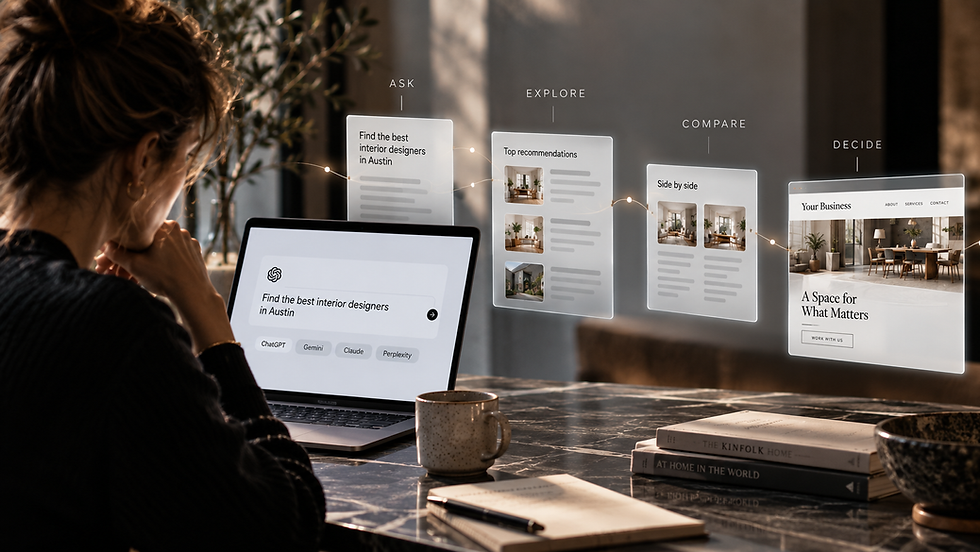
Now people are asking ChatGPT, Gemini, Claude, Google, TikTok, and whatever else is sitting between impulse and decision what to buy, where to go, who to hire, what to read, what to wear, and what matters.
That is the part I cannot stop thinking about.
The recommendation used to arrive after the wanting.
Now the wanting often arrives wrapped inside the recommendation.
The thing finds you so many times that eventually it starts to feel like your idea.
A recent Guardian piece asked almost this exact question: have I been influenced, or is this actually me? It named something I think a lot of people feel but do not always say out loud.
Personal taste is starting to feel blurry.
I feel that in my chest.
Because taste used to require a little more... wandering.
You heard a song in someone else’s car and asked what it was.
You walked into a room and felt your body decide before your brain explained why.
You bought the strange jacket and risked being wrong.
There was embarrassment in it.
There was discovery.
There was the private little thrill of choosing before the world had fully agreed with you.
I do not think influence is the problem
We are supposed to be influenced.
By rooms. By people. By weather. By someone’s old coat. By the restaurant where the lighting makes everyone look like they made better choices that day.
Influence is part of being alive.
What feels different now is the speed.
There is less space between seeing and wanting.
Less time for the little internal instrument to tune itself before the next suggestion arrives.
That internal instrument is taste.
And I do not mean taste as snobbery.
I mean taste as self-recognition.
Taste is the ability to feel something and know whether it actually belongs to you.
This is where I think the real trend is
The real trend is that people are being helped into decisions so efficiently that they are starting to question whether the desire was ever theirs.
Adobe recently reported that shoppers arriving at retail sites from large language models generated 53 percent more revenue per visit than non-AI traffic.
McKinsey has called AI search the new front door to the internet, noting that half of consumers already use AI-powered search and that it could influence $750 billion in revenue by 2028.
That all matters.
But the human question underneath it matters more.
When the answer gets better, what happens to the pause?
When the recommendation gets more personal, what happens to the person?
I keep coming back to the human yes
A brand can be recommended and still not be remembered.
A place can be easy to find and still not feel like somewhere you want to be.
A room can photograph beautifully and still feel empty when you walk into it.
A story can be perfectly optimized and still sound soul-less.
That is the part I care about.
The human yes.
When you see a place and feel your shoulders drop.
When someone explains an idea and your brain lights up because it finally has a shape.
When a recommendation does not just shorten the path, but somehow gives you back to yourself.
That is rare.
And I think it is going to become more valuable.
The future of visibility cannot only be about appearing.It has to be about being recognized.
Maybe taste is becoming strategy
I have spent a lot of my life noticing the thing other people almost walked past.
A room that could be more than a room.
A story that had not found its language yet.
A partnership that felt obvious the second someone said it out loud.
An audience sitting right there, open and available, while everyone else was chasing attention somewhere louder.
That is taste, too.
Strategic taste.
The ability to recognize fit before it has proof.
To feel when something belongs in the same frame.
To know when a thing has life in it, even if the spreadsheet has not caught up yet.
AI will keep getting better at surfacing options. It will summarize the internet. Compare products. Suggest vendors. Tell people what other people seem to trust.
But someone still has to know what feels right.
Someone still has to know when the room is warm.
Someone still has to know when the language sounds human.
Someone still has to know when the match is real.
I think people are going to crave proof of life
That may be the next premium.
The sense that a real person stood somewhere, noticed something, chose something, cared about something, and made a decision that did not come pre-softened by the feed. Something imperfect and human and passionate and full of, well, life.
Until then, I am trying to pay attention to the pause
The moment before the cart, before the booking... before the yes.
That small private space where a person gets to ask:
Do I actually like this?
I think that question is going to matter more than we realize.
Because if everything can be recommended, taste becomes one of the last places we still get to meet ourselves.


Comments